-
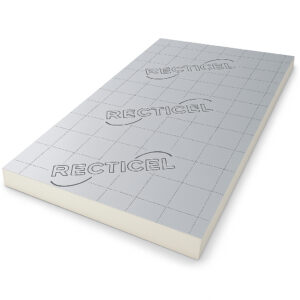

40mm Recticel Eurothane GP PIR Insulation Board 2400mm x 1200mm (8′ x 4′) 2.88m2
40mm Recticel Eurothane GP is a polyisocyanurate (PIR) insulation core with composite aluminium foil facings on both sides. Recticel is a multi-purpose insulation board suitable for use in pitched roofs, ceilings, floors and walls.
£19.93£23.92 Ex VATInc VAT£6.92£8.30 Per M2 Add to cart
Our specialist stores
Our specialist stores

40mm Loft Insulation Eurothane GP
40mm loft insulation sits within a practical intermediate thickness range. It is not a top-up mineral wool layer, and it’s not a full standalone cold loft solution either. Instead, it is a controlled insulation layer with a defined thermal contribution used where you need thermal improvement without losing too much build-up height.
40mm loft insulation thickness is often chosen because space is tight, detailing matters, or you are building up a layered system.
What is 40mm loft insulation thickness?
Insulation loft 40mm thickness refers to PIR boards or rock mineral wool slabs manufactured to a nominal thickness of 40mm. The depth influences thermal resistance (R-value), and overall performance depends on the material:
- PIR: Thermal conductivity around 0.022 W/mK, rigid and foil-faced, giving approximately 1.8 m²K/W at 40mm.
- Rock mineral wool: Thermal conductivity around 0.034–0.040 W/mK, semi-rigid, non-combustible, giving approximately 1.0–1.1 m²K/W at 40mm.
Depending on product type, loft insulation 40mm thick may be:
- Rigid board – PIR
- Semi-rigid slab – rock mineral wool
Each material delivers different structural and thermal characteristics in terms of:
- Compression strength
- Moisture resistance
- Vapour control, and
- Fire classification
What is 40mm thick loft insulation used for?
Thick 40mm loft insulation is often a build-up layer common in:
Pitched roofs
Installed between or beneath rafters as part of a warm roof build-up. On its own, it will not achieve typical Part L target U-values, but as an under-rafter layer, it reduces thermal bridging through timber.
Flat roofs
Used above deck (warm roof design) or between timber joists when part of a layered roof insulation system. PIR rigid insulation boards are preferred here due to compressive strength and moisture resistance. In flat roofs, compressive strength matters more above deck than between joists.
Floors
In refurbishments where floor height is restricted. 40mm PIR can sit beneath chipboard or screed. For heavy-duty floor insulation use, higher compressive strength grades are required (often 300kPa or higher).
Internal masonry walls
Used as a drylining backing board to improve the thermal performance of solid brick or block walls.
Across a variety of applications, 40mm insulation functions as a strategic layer within a designed assembly.
Types of 40mm loft insulation
We supply these forms of 40mm thick loft insulation:
PIR (polyisocyanurate)
The key features of 2400mm x 1200mm x 40mm include:
- High insulation performance for its depth.
- Foil-faced loft insulation boards.
- Good compressive strength.
- Approximate R-value at 40mm is 1.8 m²K/W.
- Euroclass B fire rating (subject to product facer and tested system)
- Common on roofs and floors.
- Joints should be taped where the board is acting as a vapour control layer.
The main features of rock mineral wool for loft insulation include:
Rock mineral wool
- Semi-rigid to rigid slabs.
- Euroclass A1 non-combustible.
- R-value at 40mm is ~1.0–1.1 m²K/W.
- Excellent acoustic performance.
- Ideal for walls, between rafters, and partitions. Can be friction-fit between studs or timber joists.
Each material affects the structural and thermal performance of a 40mm insulation layer.
Benefits of using 40mm loft insulation in UK homes
Installing 40mm thick loft insulation has the following benefits:
- Improves thermal resistance in tight spaces (especially PIR insulation board)
- Reduces thermal bridging when layered correctly
- Helps upgrade older roofs and floors without a major rebuild
- Supports compliance when combined with deeper insulation boards.
- Lightweight and easy to install.
- 40mm PIR insulation for lofts is available in high compressive strength grades
- Rock mineral wool improves acoustic separation in wall insulation applications.
- Rock mineral wool is Euroclass A1 non-combustible and can improve fire performance when used within a tested system.
At Insulation Wholesale, you can purchase 40mm Loft Insulation at low wholesale prices with fast delivery for most of items within 2-5 days. Competitive rates guaranteed.
FAQ
How to cut 40mm loft insulation?
- PIR: sharp fine-toothed saw or insulation knife. Score and snap works on thinner boards.
- Mineral wool: Use a long-bladed insulation knife to cut the loft insulation foil blankets 40mm. Cut slightly oversize for a friction fit.
Cut on a stable surface to get even cuts. Poor cuts create gaps, and gaps equal heat loss.
How to fix 40mm loft insulation?
Fixing will depend on the substrate and material:
- Between rafters or studs: Friction fit if sized correctly. Cut the rock mineral wool slightly oversized so it holds itself in place. PIR boards should fit snugly without compression.
- Under rafters: Mechanically fix boards with insulation fixings and large washers, then tape joints. Rock mineral wool can be friction-fitted or supported with timber battens.
- Floors: Lay boards over DPM where required. Should be tightly butted. Rock mineral wool is rarely used under floors due to compressive limits.
- Masonry walls: Use appropriate insulation fixings or adhesive systems.
Checklist:
- Stagger joints
- Tape foil-faced boards
- Maintain vapour control where required
- Follow the manufacturer's fixing patterns
Where to buy 40mm loft insulation?
You can buy your 40mm loft insulation online from Insulation Wholesale. We stock PIR boards and rock mineral wool slabs. Everything is UK stock, ready for prompt nationwide delivery to your site.