200mm insulation board is used when the job calls for serious thermal performance. It is a practical option for roofs, floors, and some wall build-ups where lower U-values are part of the spec.
What is 200mm thick insulation board?
A 200mm thermal insulation board is a rigid thermal panel manufactured to a precise 200mm depth, suitable for wall, floor, and roof insulation applications. In the UK, this most commonly means a 200mm PIR insulation board (polyisocyanurate foam) with foil facings bonded to both sides.
It is defined by:
Core material is usually PIR. A closed-cell rigid foam, such as 200mm Celotex XR4000, is ideal for high-performance insulation. The cells trap gas, which reduces heat transfer.
Foil facings. Thin aluminium layers are laminated to each side. These improve thermal performance and can function as a vapour control layer when joints and penetrations are properly sealed.
Declared thermal conductivity λ-value. Typically around 0.022 W/m·K for leading brands, although some products are lower or higher depending on type and range.
Compressive strength – Typically 120–150kPa, depending on product type (check manufacturer data for floor loading suitability)
A 200mm PIR board with a declared lambda of 0.022 W/m·K has an R-value of about 9.0 m²K/W.
While PIR is the most common format, other materials are also available in 200mm depth (such as EPS or mineral wool slabs).
What is 200mm insulation board used for?
Thick 200mm insulation boards are commonly used on:
Floors
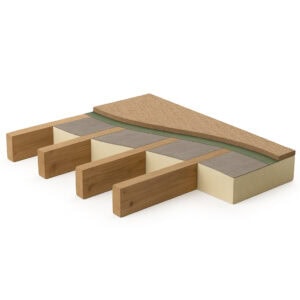
In ground-bearing concrete slabs, a thick insulation 200mm board may be laid above a damp-proof membrane and below the screed, subject to floor design and damp strategy. PIR boards can be suitable here where sufficient compressive strength is stated, provided loading calculations are correct.
In suspended beam-and-block floors, boards may be specified in beam-and-block floor build-ups, subject to the floor design. Edge insulation is still required to prevent cold bridging.
Because of the depth, you must account for finished floor levels early in the design.
Roofs
A 200mm insulation thickness board is common in:
Warm flat roofs (single-layer or built-up systems)
Pitched roof between/under rafter systems can benefit from improved cavity air spaces.
Room-in-roof conversions
For loft projects, a 200mm loft insulation board is sometimes used instead of mineral wool when:
Headroom is limited
You need a firm decked surface
You want higher thermal performance per millimetre
Rigid boards give more insulation per thickness than fibrous insulation, such as mineral wool.
Walls
In masonry cavity walls, 200mm is generally too thick for standard cavities unless designed for wide cavities from the outset. Standard cavities are typically 100-150mm.
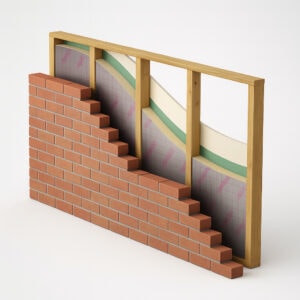
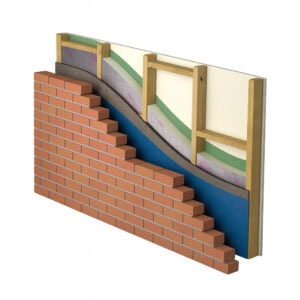
In timber frame or SIPS-style builds, insulation 200mm thick board can form part of the structural envelope.
In internal wall upgrades, this depth would significantly reduce room size, so it’s usually reserved for major refurbishments rather than light retrofits.
How many types of 200mm insulation board are there?
Even at 200mm, products vary by core, facing, and intended use.
These are rigid, foil-faced, and the most common, with high thermal performance. They include products from major UK manufacturers such as Celotex XR4200.
Phenolic foam boards are more expensive and more brittle than PIR. They have slightly lower λ-values (around 0.018–0.020 W/m·K) depending on the product, making them a preferred choice in the green guide. This means they deliver marginally better performance per thickness.
EPS boards are often a lower-cost, higher λ-value (~0.030–0.038 W/m·K) option. To match PIR performance at 200mm, you would usually need thicker EPS, either in singular boards or layered.
Slabs are available in 200mm depth and are mainly used for acoustic or fire performance in walls and roofs, particularly when combined with plasterboard. They have a thermal conductivity of around 0.034–0.037 W/m·K.
Each type has different strengths, fire ratings (Euroclass), moisture resistance, and detailing requirements.
Benefits of thick 200mm insulation board
A thick insulation 200mm board offers practical, measurable advantages:
High R-value in a single layer – Reduces the need for multiple boards and extra fixings.
Better control of heat loss – Helps achieve the low U-value required under Approved Document L.
Reduced cold bridging (when detailed properly) – Especially in continuous roof layers.
Long-term performance stability – When correctly installed, some closed-cell boards, such as PIR and XPS, resist moisture absorption.
But remember the board alone does not guarantee results; performance depends heavily on airtightness, detailing, and correct installation.
At Insulation Wholesale, you can purchase 200mm Insulation Board at low wholesale prices with fast delivery for most of items within 2-5 days. Competitive rates guaranteed.
FAQ
What are the thermal properties of 200mm insulation board?
A typical 200mm PIR insulation board has:
Thermal conductivity (λ) – ~0.022W/m·K
Thermal resistance (R) – ~9.0m²K/W
Compressive strength – Commonly 120–150kPa
Water absorption – Very low (closed-cell structure)
Euroclass fire rating – Commonly Class E for PIR, but varies by product (check manufacturer data sheet)
For comparison:
200mm mineral wool: R ≈ 5.4–5.8m²K/W
200mm EPS: R ≈ 5.2–6.6m²K/W
Confirm declared values from the specific product’s BBA certificate or manufacturer's technical sheet to know the exact values you are getting.
Order 200mm insulation thickness boards at low wholesale prices, and we’ll quickly deliver them to your UK site or home.
How to install 200mm insulation in a loft space?
If using a 200mm loft insulation board:
Check joist depth and structural capacity.
Ensure ventilation strategy is correct (especially in cold roofs).
Cut boards tightly between rafters or lay continuously above.
Tape all joints with foil tape to maintain vapour control.
Do not compress the boards.
Seal all perimeter gaps with expanding foam where appropriate.
You must also maintain safe access and avoid blocking eaves ventilation unless switching to a warm roof design.
Because boards are thick and rigid, accurate cutting is essential to ensure they fit well and insulate effectively. Poor fit creates thermal bypass (unintended heat flow paths). Always refer to the manufacturer's installation guidance to achieve the best results.
How effective is 200mm insulation board for home walls?
Thermally, a 200mm insulation board is very effective.
A 200mm PIR insulation board, such as the Celotex XR4000 PIR insulation board, in a properly detailed wall can produce very low U-values – often below 0.15W/m²K subject to full wall build-up and detailing.
However, effectiveness depends on:
Stud or cavity width
Thermal bridging through timber or metal
Airtightness
Junction detailing
If gaps, compression, or poor sealing occur, performance drops. But when installed correctly, 200mm provides a high level of resistance to heat loss.
Where to buy 200mm insulation board?
You can buy a 200mm insulation board online from Insulation Wholesale, including options with low-emissivity foil facing. We stock and supply a wide range of 200mm PIR insulation boards from trusted brands, with UK stock available for immediate delivery to your site. Our store offers competitive pricing and clear trade discounts on both single-pack and pallet orders.
200mm XR4200 is a polyisocyanurate (PIR) insulation core with composite aluminium foil facings on both sides. Celotex is a multi-purpose insulation board suitable for use in pitched roofs, ceilings, floors and walls.
£1,452.11£1,742.53Ex VATInc VAT£42.02£50.42Per M2Add to cart