Our specialist stores
Our specialist stores


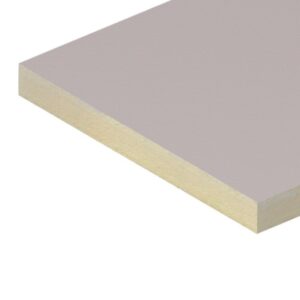
90mm Insulation Eco-Bond
90mm insulation refers to insulation materials manufactured to a 90mm thickness for use in floors, walls, and roofs. It is a commonly specified thickness size in most construction projects where drawings call for an insulation thickness 90mm.
What is 90mm thick insulation?
90 mm thick insulation is insulation that measures 90mm from face to face. It is a mid-range depth, thicker than 50mm but thinner than 150mm. This makes it a practical choice when space is limited or when you require specific thermal performance.
Insulation Wholesale supplies 90mm soft insulation, including mineral wool rolls and slabs, and 90 mm hard insulation, including PIR boards. Each material has different performance characteristics depending on its use.
What is 90mm insulation used for?
In practice, this thick 90mm insulation is installed in building elements requiring moderate thermal resistance without excessive build-up depth:
- Walls – between studs or in cavities as part of the overall wall build‑up.
- Floors – under screed or between joists to cut heat loss.
- Roofs – between rafters or joists, if the depth allows.
- Partitions & ceilings – where space is limited, but some insulation is still needed.
Using insulation 90mm thick in these elements helps reduce heat loss, lower energy bills, and keep rooms more comfortable year‑round.
Types of insulation in 90mm thickness
Two main types of 90mm insulation thickness are commonly used:
90mm Soft insulation
These are flexible, often fibrous products, such as glass wool or mineral wool. They are compressible and fit effortlessly between timber or steel framing. Lightweight and easy to cut, they are the better choice for acoustic and fire protection.
A slab of typical mineral wool will have an R-Value of R 2.3–2.7 at 90 mm thick insulation (based on typical lambdas for mineral wool).
While mineral wool 90 mm can be used between rafters in cold roofs, especially where acoustic or fire performance is valued, greater thicknesses are often required to meet current U-value targets.
It can be installed in stud partitions or in external walls with a cavity, but greater thicknesses may be required to achieve lower U-values.
90mm Rigid insulation
These are rigid boards made from foam polymers like PIR. They are flat, firm, and provide a reliable, straight edge. Great for snug fits and minimising gaps that let heat escape. They are often preferred when high thermal performance is needed within a limited space.
PIR Rigid Boards (high‑performance foam) – Often deliver a thermal resistance of 4.0–4.5 m²·K/W at 90 mm thickness, depending on manufacturer. Some PIR boards show ~4.25–4.50 m²·K/W at 90 mm thick insulation.
PIR has a low thermal conductivity (~0.021–0.022 W/m·K), so even at 90 mm, it effectively resists heat.
PIR 90mm boards are popular under screeds or between joists when you need a decent R‑value without lowering finished floor level too much.
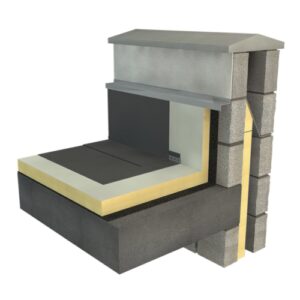
Often used in warm-roof builds between rafters or above decking where space is constrained.
Used in stud walls (timber or metal) or cavity walls where space is limited because it gives a strong R‑value for the space.
Other boards (EPS / XPS / Phenolic) – EPS/XPS polystyrene generally sit between mineral wool and PIR in performance.
EPS typically achieves ~R 2.6–3.0 m²·K/W at 90 mm thickness. Phenolic foam can slightly outperform PIR, but is not as commonly used in standard UK wall/floor boards.
XPS and EPS boards at 90mm thickness are well-suited for ground floors because they resist moisture well and have high compressive strength.
Benefits of 90mm thick insulation
This thickness offers a practical balance for many jobs:
- Thermal control – slows heat flow well for typical wall/floor/roof slots.
- Space‑friendly – does not eat up too much space where depth matters.
- Ease of installation – flexible insulation, such as mineral wool, compresses into place while hard insulation cuts perfectly and fits snugly.
- Energy saving – when installed correctly, it helps reduce heating costs.
- Acoustic performance – soft insulation, such as mineral wool, provides effective sound absorption; rigid boards offer limited acoustic benefit.
Why choose our insulation 90mm?
Here’s why you can confidently choose 90mm soft insulation or 90mm hard insulation from Insulation Wholesale:
- We stock 90mm insulation panels from trusted UK manufacturers.
- Our 90mm stock covers a range of soft and hard types, so you can pick what suits your task.
- All 90mm boards and slabs are sized correctly for building work and are easy to cut and place.
- We are on standby to help you choose the right item.
At Insulation Wholesale, you can purchase 90mm Insulation at low wholesale prices with fast delivery for most of items within 2-5 days. Competitive rates guaranteed.
FAQ
Where to buy 90mm Insulation?
You can buy 90mm thick insulation online from Insulation Wholesale. We stock a wide range of soft and rigid insulation materials suitable for trade and DIY projects.