


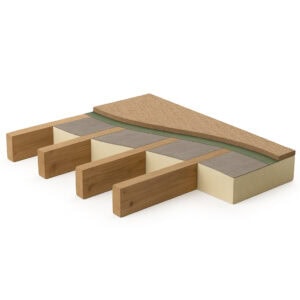
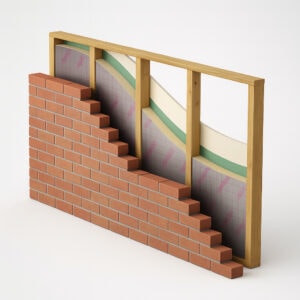
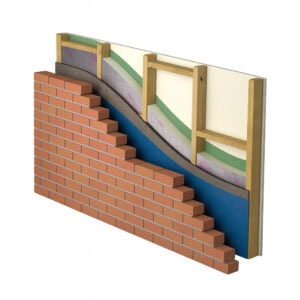
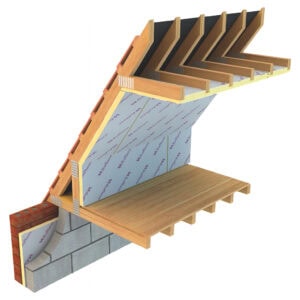
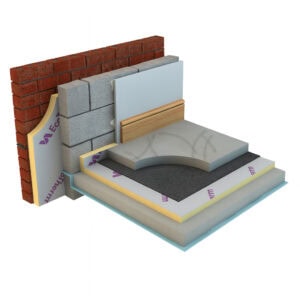
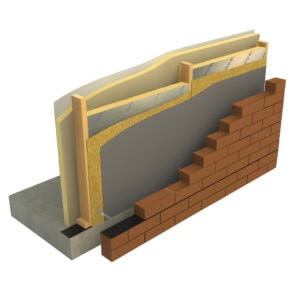
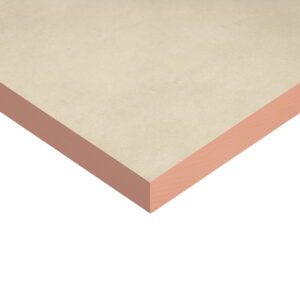
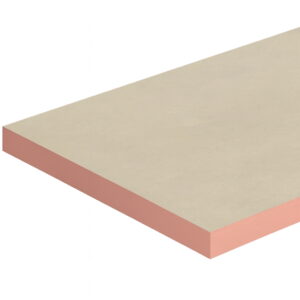
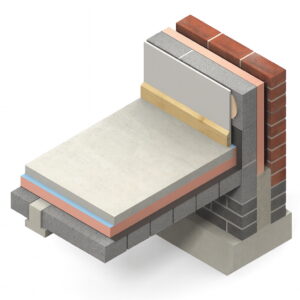
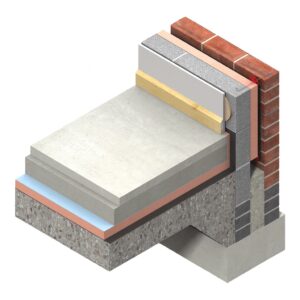
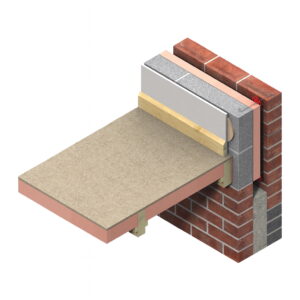

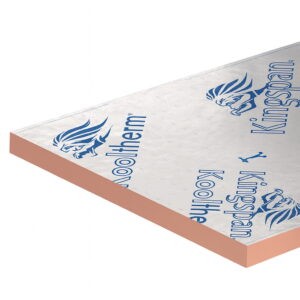
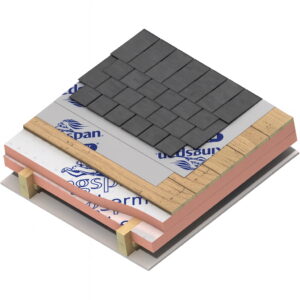
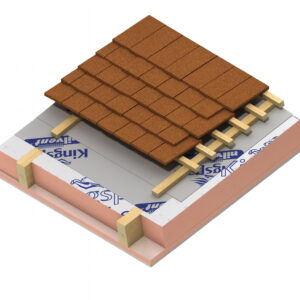

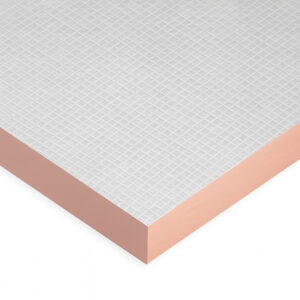
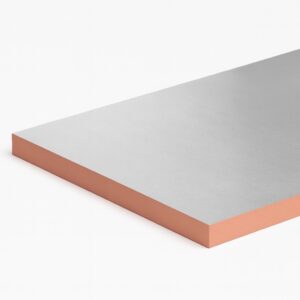
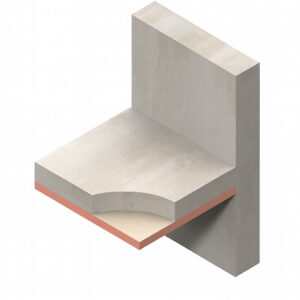

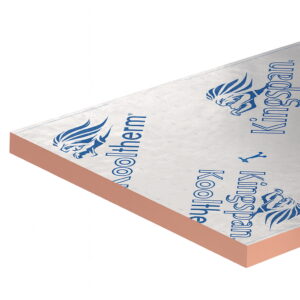
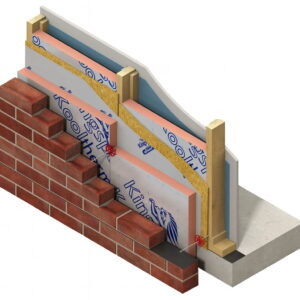
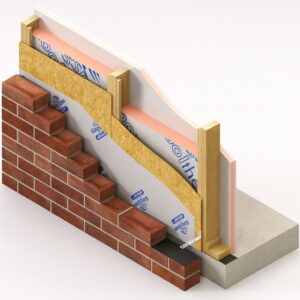
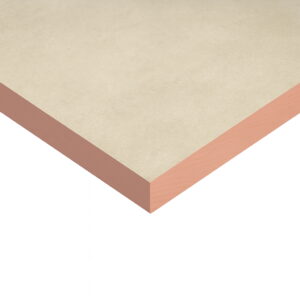
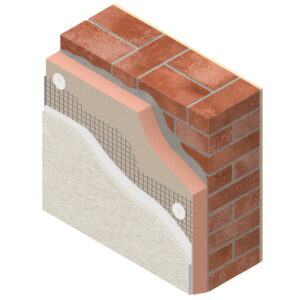
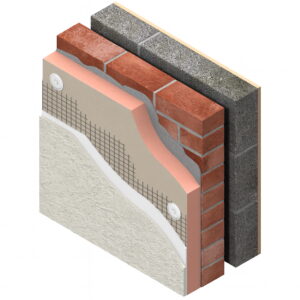
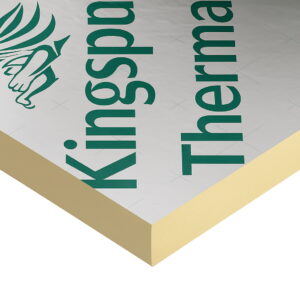
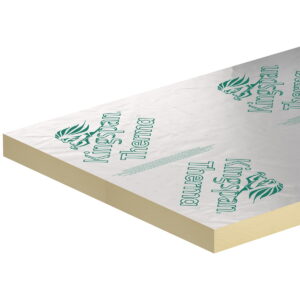
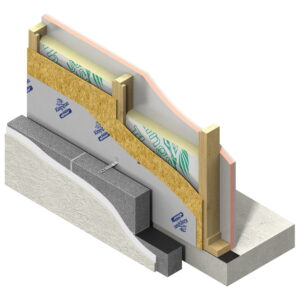
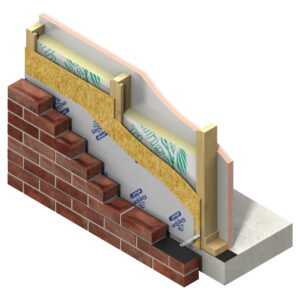
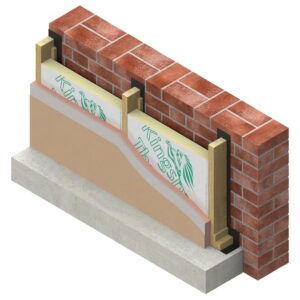
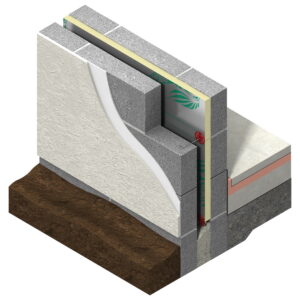
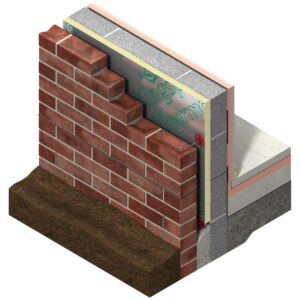
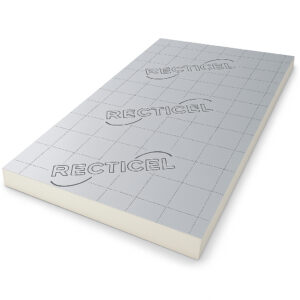
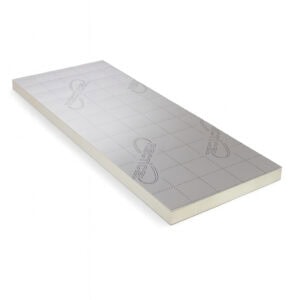
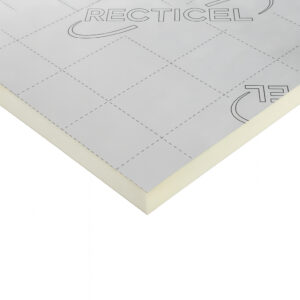
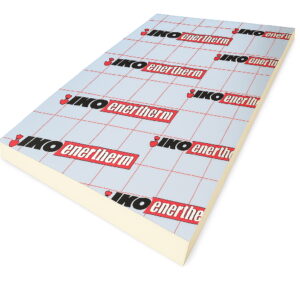
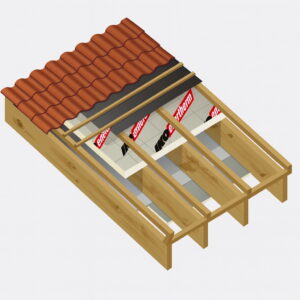
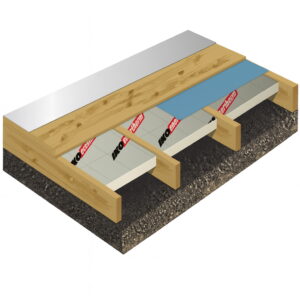


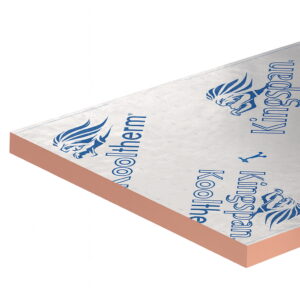
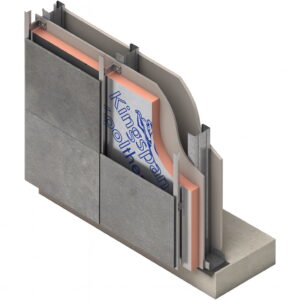
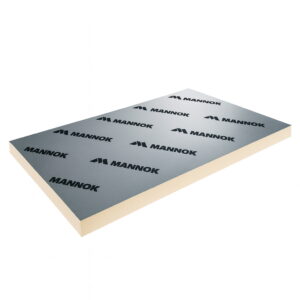
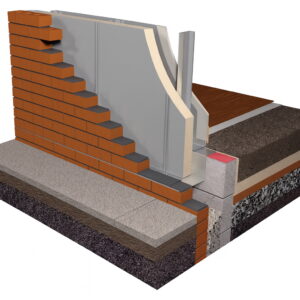
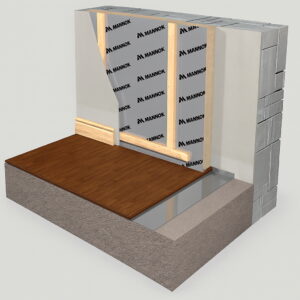
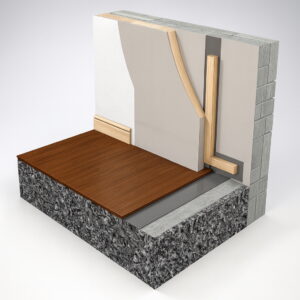
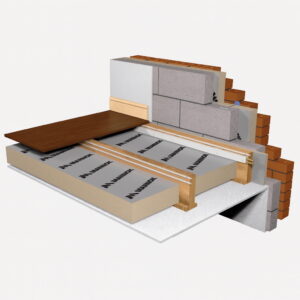
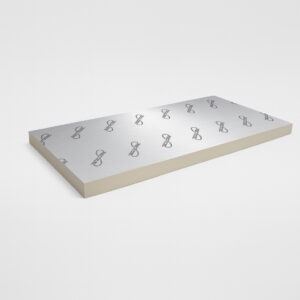

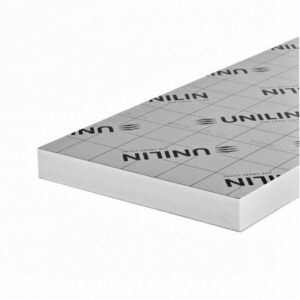
70mm Unilin Thin-R PIR insulation is a foil faced, high-performance insulation solution that offers exceptional thermal efficiency and durability. This polyisocyanurate insulation board, formerly known as Xtratherm, is ideal for a range of applications, such as floors, pitched roofs, and walls.
70mm Insulation
70mm insulation sits between thin lining insulation and deeper structural insulation layers. It is ideal when a project requires a significant thermal improvement but cannot accommodate the space required for thicker insulation.
It is a suitable choice for refurbishment work, lining upgrades, and tight timber details.
What is 70mm thick insulation?
70mm thick insulation, sometimes referred to as insulation thick 70mm, measures exactly 70 millimetres when installed at its nominal thickness.
This depth of insulating material reduces heat transfer by trapping still air (soft products) or by resisting heat flow through rigid foam boards.
While it is 10mm slimmer than 80mm thick insulation, the mechanism at work is the same: less heat escapes, resulting in improved thermal retention within the building.
What is 70mm insulation thickness used for?
70mm insulation boards and slabs are typically used when the build-up will not allow that extra depth. Common uses include:
- Internal wall upgrades where space is tight
- Timber stud partitions
- Warm roof constructions where rafter depth or build-up height is restricted (usually part of a multi-layer build-up)
- Floors above unheated spaces, such as garages or voids
Types of 70mm insulation
Installers consider placement, fit, moisture risk, and required installation skills when choosing one type of 70mm insulation over another. The types of products available in 70mm insulation thickness include:
70mm soft insulation materials (mineral wool, glass wool): These rely on air pockets and are more tolerant of minor dimensional variation. Therefore, you do not need to cut them to the exact size that fits the space; they can be cut slightly wider or oversized and still fit snugly due to their compressible nature.
70mm hard insulation boards (PIR, phenolic, EPS, XPS): These resist heat flow more strongly per millimetre but demand precise cutting.
70mm Mineral wool insulation
It is made from spun rock fibres pressed into slabs. It has a dense yet springy structure and holds its shape once fitted.
Works by trapping still air between fibres. Typical thermal conductivity ranges from 0.035 to 0.040 W/m.K. It is noncombustible and vapour-permeable, allowing moisture to pass through the structure.
Best for stud walls, partitions, and floors between joists. Also used where fire resistance and sound control matter as much as heat retention.
70mm Glass wool insulation
Formed from molten recycled glass spun into a lightweight, fibrous mat. It relies on air pockets to restrict heat flow and has a thermal conductivity of 0.032–0.040 W/m.K.
A compressible material that is common in timber frames, loft slopes, and wall linings, where insulation should friction-fit into place.
70mm PIR insulation
A rigid foam board with a foil face on each side. Foil facings can help reduce radiant heat transfer when installed adjacent to an air space.
Lightweight yet stiff, it offers strong thermal resistance for its depth, with thermal conductivity of 0.022–0.026 W/m.K.
It provides high thermal resistance in space-constrained areas, such as internal wall linings, warm roofs, and floor build-ups.
70mm Phenolic insulation
This is a closed-cell foam similar to PIR but with a finer internal structure.
It offers slightly better thermal performance than PIR, typically 0.020–0.023 W/m.K. It is more brittle than PIR and therefore requires careful handling during installation.
Ideal when maximum insulation is needed in the smallest possible depth, especially in projects with strict build-up limits.
70mm EPS insulation
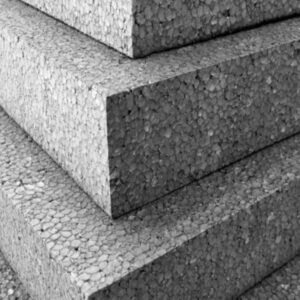
These are light panels made from expanded polystyrene beads fused together. They are vapour-permeable and dimensionally stable compared to closed-cell foams.
Their thermal conductivity typically ranges from 0.030 to 0.038 W/m.K, depending on grade.
Common in floors and cavity wall systems. Also, for areas that need a balance of insulation and breathability.
70mm XPS insulation
XPS is a denser form of polystyrene with a smooth, closed-cell surface. It maintains performance even in damp conditions.
Has lower water absorption than EPS with typical thermal conductivity values of approximately 0.029–0.034 W/m.K. Ideal for floors, inverted roofs, and ground-contact areas where moisture resistance is critical.
Benefits of insulation 70mm thickness
70mm delivers gains such as:
- Noticeable heat-loss reduction
- Easier detailing around windows and services
- Less disruption in refurb projects
- Compatible with many existing frames
- Improves occupant comfort in addition to lowering U-values
At Insulation Wholesale, you can purchase 70mm Insulation at low wholesale prices with fast delivery for most of items within 2-5 days. Competitive rates guaranteed.
FAQ
Where to buy 70mm insulation?
You can buy insulation 70mm online from Insulation Wholesale. We stock both soft and rigid options, supply well-known UK brands, and keep pricing competitive across thicknesses. Our team helps you match the insulation to the build detail, not just the spec sheet, so the correct product is specified and installed the first time.
How to cut 70mm insulation?
- Soft insulation: Use a long knife or saw and cut slightly oversize.
- Rigid boards: Score deeply along a straight edge, then snap or saw for clean edges.
Always aim for snug contact, as gaps allow heat to pass through the material more freely.
How much is 70mm insulation?
Prices vary by material. Products offering higher thermal performance per millimetre typically cost more.
- Soft insulation rolls or slabs typically cost £4–£8 per m².
- Rigid foam boards are typically £10–£20 per m², depending on type and brand.
Please note that these price ranges are indicative and significantly vary by brand, specification, and order volume.
Showing all 19 results
-
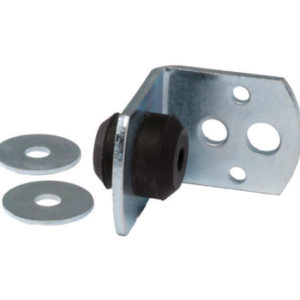
70mm Bracket Evolution Acoustic Ceiling Hanger Box of 100
70mm Bracket Evolution Acoustic Ceiling Hanger Box is a high-quality solution designed to support acoustic ceiling systems and reduce noise transmission.
£139.87£167.84 Ex VATInc VAT£1.40£1.68 Per Unit Add to cart -
70mm Celotex GA4070 PIR Insulation Board 2400mm x 1200mm (8′ x 4′) 2.88m2
70mm Celotex GA4070 is a polyisocyanurate (PIR) insulation core with composite aluminium foil facings on both sides. Celotex is a multi-purpose insulation board suitable for use in pitched roofs, ceilings, floors and walls.
£26.09£31.31 Ex VATInc VAT£9.06£10.87 Per M2 Add to cart -


70mm Ecotherm Eco-Versal PIR Insulation Board 2400mm x 1200mm (8′ x 4′) 2.88m2
70mm Ecotherm Eco-Versal is a polyisocyanurate (PIR) insulation core with composite aluminium foil facings on both sides. Ecotherm Eco-Versal is a multi-purpose insulation board suitable for use in pitched roofs, ceilings, floors and walls.
£25.00£30.00 Ex VATInc VAT£8.68£10.42 Per M2 Add to cart -
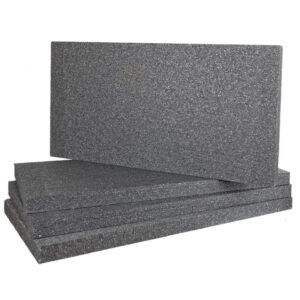
70mm Jablite HP+ 70E External Wall Insulation Board 1200mm x 600mm (4′ X 2′) Pack of 8 (5.76m2)
70mm Jablite HP+ 70E External Wall Insulation Board is designed to enhance thermal efficiency for external walls. It can be bonded or mechanically fixed, providing reliable insulation solution.
£44.00£52.80 Ex VATInc VAT£7.64£9.17 Per M2 Add to cart -
70mm Kingspan Kooltherm K103 Insulation Floorboard 2400mm x1200mm Pack of 4 (11.52m2)
70mm Kooltherm K103 is a premium phenolic core floor insulation solution, designed to deliver exceptional performance with solid concrete or suspended timber floors.
£280.37£336.44 Ex VATInc VAT£24.34£29.21 Per M2 Add to cart -
70mm Kingspan Kooltherm K107 Pitched Roof Board 2400mm x 1200mm Pack of 4 (11.52m2)
70mm Kingspan Kooltherm K107 Pitched Roof Board is a premium performance insulation with a fibre-free rigid thermoset phenolic core. It is used to insulate pitched roofs and attic spaces, and has a thermal conductivity of just 0.019 W/m.K across all thicknesses.
£279.38£335.26 Ex VATInc VAT£24.25£29.10 Per M2 Add to cart -
70mm Kingspan Kooltherm K110 Soffit Board Insulation 2400mm x 1200mm Pack of 4 (11.52m2)
70mm Kingspan Kooltherm K110 Soffit Board Insulation enhances thermal performance in soffit areas with its slim, efficient design. It’s easy to install and improves energy efficiency.
£318.22£381.86 Ex VATInc VAT£27.62£33.14 Per M2 Add to cart -
70mm Kingspan Kooltherm K112 Framing Insulation Board 2400mm x 1200mm Pack of 4 (11.52m2)
70mm Kingspan Kooltherm K112 Framing Board is a premium performance insulation with a fibre-free rigid thermoset phenolic core. It is used to insulate timber and steel framing systems with thermal conductivity of just 0.019 W/mK across all thicknesses.
£351.18£421.42 Ex VATInc VAT£30.48£36.58 Per M2 Add to cart -
70mm Kingspan Kooltherm K5 External Wall Insulation Board 1200mm x 600mm Pack of 6 (4.32m2)
70mm Kingspan Kooltherm K5 External Wall Board is a premium performance insulation with a fibre-free rigid thermoset phenolic core used as external insulation for masonry walls.
£110.84£133.01 Ex VATInc VAT£25.66£30.79 Per M2 Add to cart -
70mm Kingspan Therma TP10 / TF70 / TW55 PIR Insulation Board 2400mm x 1200mm (8′ x 4′) Pack of 4 (11.52m2)
All three models 70mm Kingspan Therma PIR Insulation Board:
- 70mm Thermapitch TP10
- 70mm Thermafloor TF70
- 70mm Thermawall TW55
share the same high-performance PIR core and low-emissivity foil facings, offering excellent thermal efficiency and easy installation. Although labeled differently, these boards share identical technical specifications.
£146.11£175.33 Ex VATInc VAT£12.68£15.22 Per M2 Add to cart -
70mm Kingspan Thermawall TW50 PIR Insulation Board 1200mm x 450mm Pack of 6 (3.24m2)
70mm Kingspan Thermawall TW50 is a high performance insulation with thermal conductivity of 0.022 W/mK. Therma is a range of PIR insulation available in a range of thicknesses.£48.10£57.72 Ex VATInc VAT£14.85£17.82 Per M2 Add to cart -
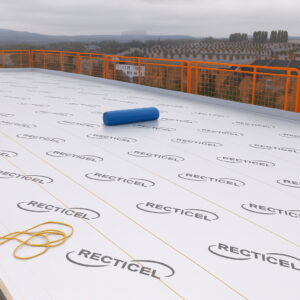
70mm Recticel Eurothane GP PIR Insulation Board 2400mm x 1200mm (8′ x 4′) 2.88m2
70mm Recticel Eurothane GP is a polyisocyanurate (PIR) insulation core with composite aluminium foil facings on both sides. Recticel is a multi-purpose insulation board suitable for use in pitched roofs, ceilings, floors and walls.
£25.13£30.16 Ex VATInc VAT£8.73£10.48 Per M2 Add to cart -
70mm Recticel Eurowall Partial Cavity Wall Insulation Board 1200mm x 450mm Pack of 14 (7.56m2)
70mm Recticel Eurowall Partial Cavity is an advanced thermal insulation panel tailored for use in cavity wall systems, delivering exceptional energy efficiency and robust performance.
£106.80£128.16 Ex VATInc VAT£14.13£16.96 Per M2 Add to cart -
70mm IKO Enertherm ALU PIR Insulation Board 2400mm x 1200mm (8′ x 4′) 2.88m2
70mm IKO Enertherm ALU PIR (polyisocyanurate) insulation is a top-quality insulation board featuring a rigid PIR foam core and reflective aluminium foil facings. It delivers outstanding thermal performance and moisture resistance, making it suitable for various installations and an ideal choice for different energy-efficient projects.
POA Get a quote -
70mm Mannok PIR Insulation Board 2400mm x 1200mm (8′ x 4′)
70mm Mannok PIR Insulation Board is an excellent choice for anyone looking for a high-performance insulation solution that provides superior thermal efficiency. It is ideal for use in any construction project, such as commercial and residential, in wall applications as well as roofing and flooring applications.
POA Get a quote -
70mm Recticel Eurothane Eurodeck Insulation Board 2400mm x 1200mm Pack of 5 (14.40m2)
70mm Eurothane® Eurodeck is compatible with mechanically fixed single-ply systems, benefiting from high compressive strength and excellent dimensional stability that ensures the flat surface finish required for optimum performance in new build and refurbishment projects. It is faced on both sides with a multi-layer coated aluminum foil.
POA Get a quote -
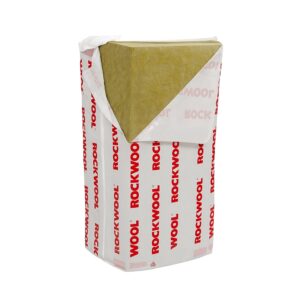
70mm Rockwool Flexi Slab Acoustic Insulation 1200mm x 600mm 92.16m2 Pallet
70mm Rockwool Flexi has been designed as a multi-use, dual-purpose acoustic and thermal mineral wool insulation with a unique flexible edge along one side. It is suitable for use all over the home, in pitched roof rafters, framed external walls, internal partitions, intermediate floors, separating walls and floors, and timber suspended ground floors.
POA Get a quote