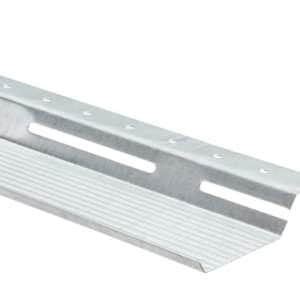
A resilient bar is a galvanised metal furring channel with a slotted fixing flange and a flexible, asymmetric profile, screwed to joists or studs. Plasterboard is then fixed to this strip instead of directly to the building structure. The tiny air gap and the flexible, asymmetric design help prevent vibrations from transmitting directly through the structure.
What are ceiling resilient bars?
The ceiling resilient bar is fixed beneath floor joists or ceiling timbers. It decouples the ceiling lining from the joists to reduce sound transmission into the room below.
What are soundproofing resilient bars used for?
Builders use resilient bar soundproofing to reduce airborne noise (voices, music) and minimise impact noise (such as dropped objects or footsteps).
They are commonly used on ceilings, but they can also be fitted on walls to reduce sound transfer between rooms. When installing resilient bars walls, the aim is the same as on ceilings – to create a decoupled layer that prevents vibrations from travelling through the structure.
They are added to upgrade wall and ceiling systems without rebuilding the whole structure. Approved Document E recognises decoupled lining systems as part of achieving sound insulation standards.
Benefits of sound resilient bars
Here are the benefits of installing sound resilient bars:
Their slim profile means they do not reduce your room’s space.
Installing resilient bars is one of the most cost-effective ways of enhancing your structure’s acoustic performance
Resilient bars provide measurable improvement in acoustic insulation by breaking the direct path that sound vibrations take.
When paired with acoustic mineral wool and double layers of plasterboard, they offer much better performance than a single direct-fixed lining.
They are corrosion-resistant because they are manufactured from galvanised metal.
Lighter and faster to fit than building a second stud wall. They must be installed with the slotted flange facing downward for proper acoustic performance.
Ideal for use in both residential and commercial structures.
Why choose our resilient bars?
Here’s why you should choose acoustic resilient bars from Insulation Wholesale:
We offer fast-access trade packs
We offer competitive prices for all products
We supply matching components like bars, fixings, and plasterboard, all in one place. Handy for tradespeople who want the right parts quickly.
Enjoy fast delivery across the UK.
At Insulation Wholesale, you can purchase Resilient Bar at low wholesale prices with fast delivery for most of items within 2-5 days. Competitive rates guaranteed.
FAQ
Where to buy resilient bar?
You can get resilient bars online from Insulation Wholesale. We stock 3m bars in packs and trade quantities. Request a quick quote and enjoy fast delivery to your home or site.
How to use resilient bar?
Fix bars so they are perpendicular to joists or studs. Keep fixings as specified by the manufacturer, using screws only through the top flange so the bar is free to flex.
Screw the plasterboard only into the resilient bar, not into the joist or studs..
Leave perimeter gaps where required and fill the cavity with acoustic sealant for the best soundproofing results.
How to install resilient bar?
Screw the bars at the spacing recommended in the datasheet (typically 400–600 mm centres).
Ensure bars are continuous and level.
Stagger board joints where possible and seal the edges.
Follow the manufacturer's data sheet for screw types and centres.
How does resilient bar work?
The resilient bar for ceiling and wall use acts as a sound ‘shock absorber’ by decoupling the plasterboard from the structure, so that vibrations have to cross a flexible junction. That bending and tiny movement disrupts sound energy transmission, so less of it reaches the next room.
Resilient Bar 3m is designed to be used to isolate the plasterboard from direct contact with the above ceiling, it works to dissipate sound reducing the transmission across the ceiling of a room.
£24.39£29.27Ex VATInc VAT£2.44£2.93Per UnitAdd to cart
UMS Resilient Bar 3m is designed to be used to isolate the plasterboard from direct contact with the above ceiling, it works to dissipate sound reducing the transmission across the ceiling of a room.
£20.00£24.00Ex VATInc VAT£2.00£2.40Per UnitAdd to cart